


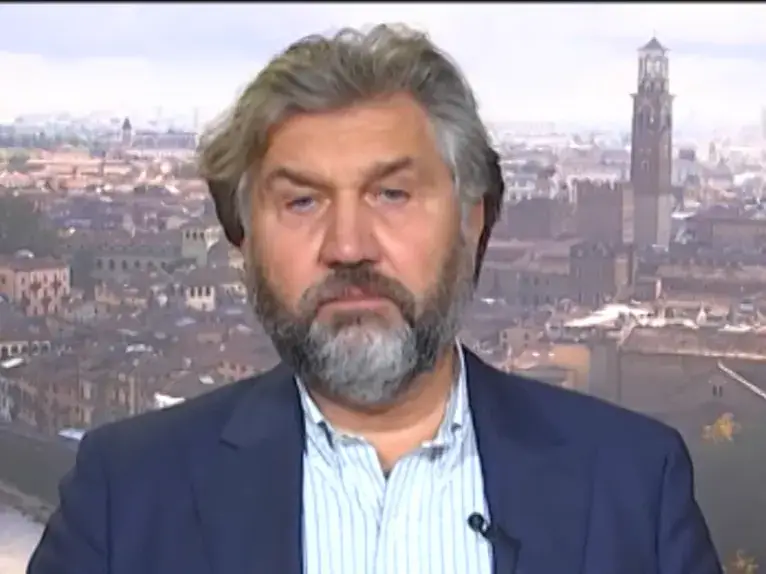
Luca Mantovani is a journalist and publisher active in the Verona area.
He moderates institutional and cultural events, including those organised by Fondazione Cariverona, and is currently editor-in-chief of «L’Arena», the most widely read daily newspaper in Verona and its province.
Paolo Mariani and Aeropittura – “The Landscape Seen from Above”
The Veronese artist presented his work at Camera dei Deputati (the Chamber of Deputies) at an event promoted by MP Rosaria Tassinari
The visual language codified in the manifesto published in 1929 and signed by artists such as Marinetti, Balla, Dottori and Prampolini translated into painting the enthusiasm for flight, speed and the machine. It was not merely a matter of seeing from above, but also of breaking the landscape down into chromatic planes and capturing the dynamism of modernity.
A century later, Paolo Mariani’s graphic works on canvas take up that legacy and bring it into the present. A native of Verona, and an aviator by passion as well as personal history, Mariani was for many years a master of the restoration of monumental heritage — from the Teatro Olimpico in Vicenza to the Uffizi, from the Quirinal Palace to the towers of San Gimignano and Juliet’s balcony in Verona — while developing a marked experimental vocation in his use of materials.
For more than forty years, he has recorded impressions and ideas in his work diaries and travel notebooks, which since 2018 he has been translating into compositions. It is a language in which Vittorio Sgarbi has recognised “a new kind of aeropainter, not an imitation of the Futurists, but their most radical intuition — moving away from things, through distance or detachment, so as to bring them into sharper focus — brought into the present.”
In recent days, Paolo Mariani’s work was presented in Rome, at Palazzo Montecitorio, as part of the celebrations marking the centenary of Aeropittura futurista (Futurist Aeropainting), during an event promoted by Rosaria Tassinari, a Forza Italia MP and member of the Chamber of Deputies’ Culture Committee.
It was a significant institutional setting, intended not only to reflect on the historical memory of an extraordinary chapter in Italian art, but also on the possibility that some of its fundamental intuitions might continue to live on in contemporary artistic research.
“The centenary of Futurist Aeropittura and Paolo Mariani’s works represent an important opportunity to highlight a fundamental chapter in the history of Italian art. Celebrating this anniversary means paying tribute to a movement that courageously and innovatively interpreted the relationship between art, technology and modernity. His works help keep this cultural heritage alive, offering the public valuable testimony to the creativity and artistic research of our country. It is the duty of institutions to support initiatives that promote culture, historical memory and Italian talent,” said Rosaria Tassinari.
Giorgio Fasol, a critic and collector of contemporary art, introduced Mariani’s figure and work, reconstructing the career of an artist whose biography defies any conventional classification.
Born in Verona in 1952, Mariani worked with crystal and fibreglass in the 1980s before becoming one of the leading figures in monumental restoration in Italy and Spain. His formative years were strongly influenced by his collaborations with architects Libero Cecchini and Tobia Scarpa.
“For years,” Fasol recounts, “he had experienced the frustration of not having time to paint — until he realised that it was enough to postpone the act of creation, not the idea itself. A sketch, a note, a word. And the image would remain safe, waiting for him.
This convergence between life and painting has a precise biographical root. Years of flying seaplanes accustomed the artist to reading the landscape as the Futurists had imagined it: a system of forces in motion, rather than a static view.
Seen from above, the earth dissolves into overlapping planes; geometries emerge where the eye on the ground cannot perceive them; light takes on a different meaning when the weight of the ground is removed.
This is not a cultural influence — it is a lived visual education at altitude, one that preceded any conscious study of Futurism and, by a different route, reproduced some of its essential tensions.
It is therefore hardly surprising that his passion for flying seaplanes ultimately came to define the very point of view of his painting: a gaze from above, suspended, embracing sky, land and water all at once.