


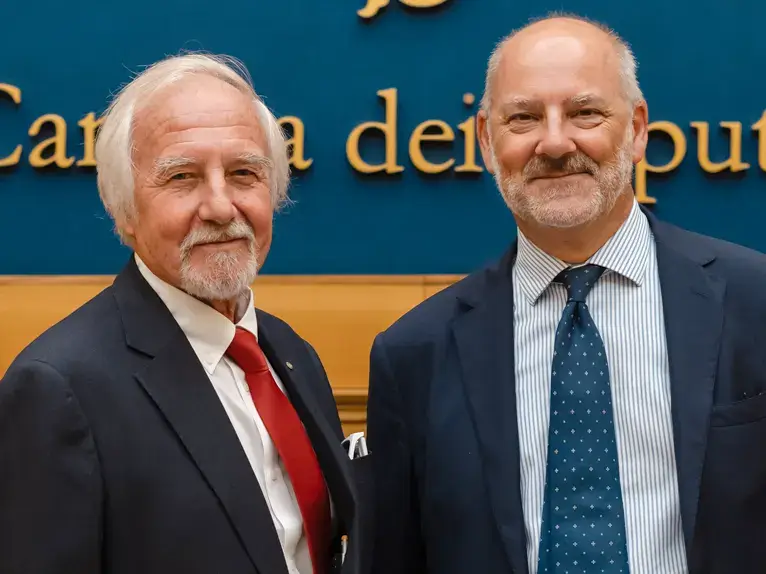
Stefano Filippi is a professional journalist and Editor-in-Chief of the monthly magazine “Tracce”, after serving as Deputy Editor and Special Correspondent for “L’Arena”, “Il Giornale”, and “La Verità”. He is the author of “Justice and the Human Person: When Prison Changes Lives” (“Giustizia e persona. Quando il carcere cambia la vita”, Bietti) and “The True Story of Pope Francis” (“La vera storia di papa Francesco”, Barbera). He is also President of the Verona chapter of the UCSI (Italian Catholic Press Union).
Camera dei Deputati, Rome – 7 july 2026
Just a few brief observations—quite personal ones, if you’ll allow me—because I came to know Paolo Mariani through a mutual friend whom I greatly admire.
I still remember the impression I had when I first saw his paintings. It was an extraordinarily powerful impression because they somehow required me to identify not only with the painting itself.
When we visit a museum, we usually move from one painting to the next. We look at a clearly defined subject, placed within a specific context. We have, so to speak, a fairly traditional way of looking at works of art.
With Mariani, you have to set that habit aside. You have to step into the painting and, in a way, step into the person behind it as well.
What fascinated me immediately was trying to understand what kind of man he was. And it soon became clear: a man full of life, full of enthusiasm, eager to act, someone who embraces reality instead of simply letting it pass him by.
Later I discovered that we also shared some common passions.
He painted places, corners of the landscape—places that were dear to him—which were not only places I knew, but places to which I, too, felt deeply attached. I’m not talking only about Lake Garda, but also the Maremma and certain corners of the Venetian Lagoon.
These are places that many people enjoy during the summer, but I have the feeling that he visits them mainly out of season. Because that’s when nature, the landscape, the environment reveal themselves at their most vivid—almost untamed.
I remember, in particular, two paintings that I truly loved.
One is “Lazise, tramonto con telefonata” (Lazise, Sunset with a Phone Call). It is a wonderful composition of colours… and then there is that little corner, that tiny detail, which becomes a human presence within the scene.
What I find beautiful is that Mariani is not sitting in judgment, saying, “This shouldn’t be here.” I imagine that, at the time, the mobile phone may have reminded him of someone being a nuisance, or of someone speaking too loudly—an experience we’ve all had. Yet there is no condemnation in the painting, no moral judgement. There is almost a sense of participation, even understanding.
It is obvious that the past matters deeply to him. If it didn’t, he wouldn’t make such use of his diary, he wouldn’t preserve his dearest and most intense memories or feel this desire to communicate them through his work. But he is not simply someone attached to the past. He is profoundly immersed in the present, and above all he is someone who looks to the future. That mobile phone—placed there quietly, tucked away in the corner, never despised—is part of our lives.
I found it a fascinating way of bringing together landscape and modernity.

My wife and I enjoy going, from time to time, to this beach in the Veneto region. You may never have heard of it. It lies in the Po Delta and is, for all practical purposes, an unknown place. The people who go there are mostly from the Province of Rovigo, or those who know the area well and appreciate this particular stretch of coastline.
That painting conveys all the force of nature, because Boccasette is a beach where, for three months of the year, there are just two bathing establishments, built in June and dismantled again in September. After that, the storms and the sea take over.
The painting captures that raw power of the natural world.
Those tree trunks, the sand with its countless colours and subtle shades of yellow, the colour of the sea… and then, within that setting, there are these small touches of red. Red is the colour of passion. It is the colour of fire. It is the colour of desire. So what is that red doing there?
My own feeling is that, in a place where untamed nature reigns supreme, it suggests a hidden passion, a living, vibrant presence.
Even the traces of human activity are, in the end, nothing more than wooden piles driven into the sand—large timber posts extending towards the sea, almost like small jetties, built simply to protect the beach. They are virtually the only human intervention in that landscape. Everything else is beach, wild shrubs and sand dunes.
The nearest houses are about six kilometres away—a seven-minute drive—so it really is a place that seems forgotten by everyone. If you’re looking for a bit of peace and quiet, I’d recommend it. It’s not even all that easy to get to, to be honest.
It seems to me that this way of portraying nature in such an essential form also echoes the centenary of Futurism and, more specifically, of Aeropittura (Aeropainting).
Aeropittura, with its particular way of seeing the world; Mariani, with his passion for flight—that desire to look at things from abov
From above, you can see everything. And yet, what do you actually perceive?
Not the detail. You perceive the essence of things.
You see the colours of the plains, the colours of the cultivated fields, the colours of the houses. You see the course of the water. In a way, you become immersed in thousands of years of geological evolution.
Looking at the world from above gives you a sense of essentiality, of purity.
And I believe that purity is precisely the hallmark of Mariani’s work. Its simplicity. Its desire to go to the very root of things.
Because every great passion ultimately contains one final desire: the desire to discover reality itself.
The deepest desire is to understand what it is that makes things what they are, what brings us into the world, and what gives birth to all the desires we carry within us.
So, in a few words, that’s what Mariani’s paintings have stirred in me, and for that I am deeply grateful to him.
I have to admit that I like him very much as a person, so I also feel a little awkward speaking about him.
But I am genuinely happy to have met him, and I sincerely wish him a future filled with satisfaction and success.